
Top 10 Silicone Cookie Spatula Manufacturers in China
Choosing a Silicone Cookie Spatula manufacturer in China takes more than comparing catalog photos and unit prices. A thin, flexible edge should slide beneath warm cookies without breaking their centers. The handle should feel secure when lifting a heavy oatmeal cookie from a crowded baking sheet. Small details matter. This guide to the Top 10 Silicone Cookie Spatula Manufacturers in China focuses on practical sourcing considerations, including material documentation, construction, customization, and quality control.
Chef and kitchen equipment expert Alton Brown offers a useful principle: “Organization will set you free.” That advice translates well into supplier evaluation: define your specifications before requesting samples, quotations, or production commitments. For a Silicone Cookie Spatula, specify head dimensions, edge thickness, handle construction, and intended operating temperatures. Request food-contact testing documentation relevant to your target market, with clear links to the proposed material and product. Verify the details. A generic certificate or an unsupported “food-grade” claim provides limited reassurance.
Even an attractive sample can leave unanswered questions about production consistency, packaging durability, and repeat-order performance. A soft edge may protect delicate cookies yet struggle with heavier bakes; greater stiffness introduces a different compromise. There is no universally perfect design, and our own preferences can make an appealing sample seem better than it performs. Buyers should compare samples using the same baking trays, cookie sizes, washing conditions, and inspection criteria. The manufacturers worth considering should explain these trade-offs clearly and support their promises with evidence buyers can check.
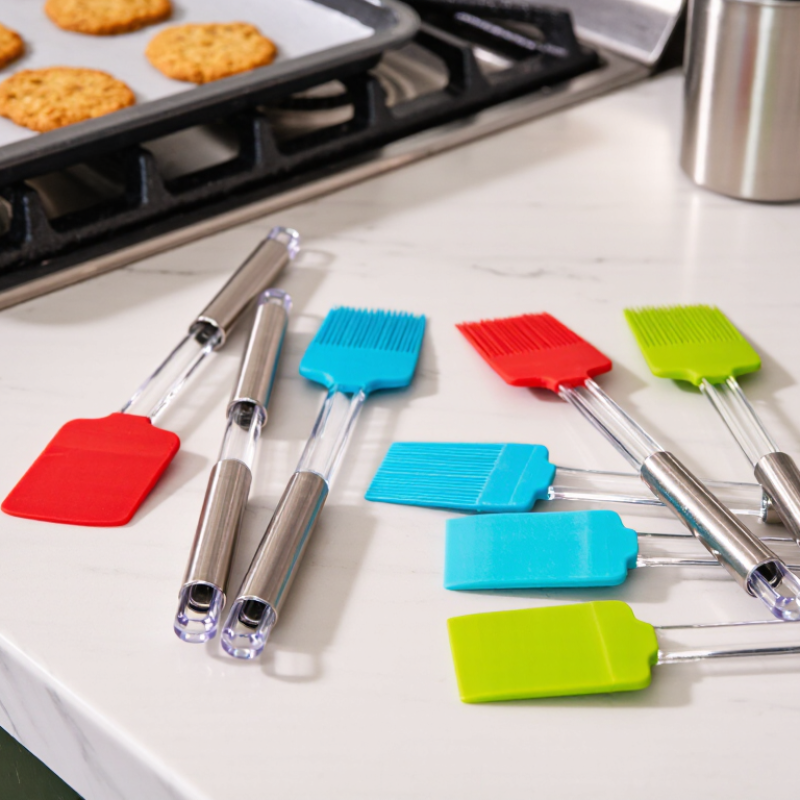
Silicone Cookie Spatulas: Materials, Designs, and Common Uses
Silicone cookie spatulas typically combine a flexible silicone head with a nylon or stainless steel core. The silicone protects baking trays from scratches, while the core supports heavier cookies. Material quality matters. When evaluating manufacturers in China, request food-contact test reports that match the exact material and intended market. A “food-grade” label alone provides little evidence of suitability. Heat limits also vary, so check the product’s stated temperature rating before using it near hot bakeware.
Design changes how a spatula handles delicate cookies. A thin, beveled edge slides beneath golden bottoms with less pressure than a thick, blunt edge. Wider heads support large oatmeal cookies, while narrow heads fit between closely spaced biscuits. Flexibility has limits. An overly soft head may fold beneath a thick chocolate-chip cookie. A stiffer design lifts securely but can feel clumsy around fragile edges. Seamless construction reduces crevices, although a bulky molded neck may still make cleaning awkward.
Common uses include transferring cooled cookies, lifting brownies, and serving small pastries from nonstick pans. Let soft cookies firm briefly before moving them; even a well-designed spatula cannot prevent every break. For supplier samples, compare edge thickness, handle grip, and bending under the same cookie weight. A comfortable handle can seem like a minor detail until several trays need emptying.
Top 10 Silicone Cookie Spatula Manufacturers in China - Silicone Cookie Spatulas: Materials, Designs, and Common Uses
The table below compares ten common silicone cookie spatula product profiles. It is a product-design overview, not a verified ranking of suppliers; no company or brand names are included. Dimensions and construction vary by model, so confirm product specifications and food-contact compliance with the manufacturer.
| No. | Product profile | Typical materials and construction | Design details | Common cookie-making uses | Selection and quality checks |
|---|---|---|---|---|---|
| 1 | One-piece mini scraper | Food-contact silicone formed as a single piece; no separate internal handle is required. | Compact head with a straight or gently curved edge for small bowls and jars. | Scraping small amounts of cookie dough, icing, or melted chocolate from containers. | Check that the head and handle have no cracks, voids, or rough molding edges; confirm the stated temperature range. |
| 2 | Classic flexible spatula | Silicone working head; handle may be silicone or a separate rigid material, depending on the design. | Broad, flexible blade with a rounded edge that follows the curve of a mixing bowl. | Folding flour into cookie batter and scraping dough from bowl sides. | Assess blade flexibility, edge finish, handle comfort, and whether the head is securely joined to the handle. |
| 3 | Double-sided scraper | Silicone head with two working edges; some designs use a rigid internal support. | Different edge shapes on either side, such as a rounded edge and a narrower edge. | Scraping mixing bowls and transferring dough or icing to a work surface. | Inspect both edges for smoothness and check that any core is fully enclosed. |
| 4 | Angled-edge spatula | Silicone head, typically paired with a rigid handle or an internally supported handle design. | Offset or angled head helps reach into the corners of bowls and containers. | Removing dough from bowl corners and spreading glaze on cookies. | Check that the angle is comfortable to hold and that the head does not twist excessively under normal use. |
| 5 | Narrow jar spatula | Narrow silicone head with a flexible working edge; handle construction varies by model. | Slim profile designed to fit into narrow openings and small containers. | Retrieving cookie butter, jam, or icing and scraping narrow containers clean. | Look for a smooth, continuous head surface that is easy to wash and inspect. |
| 6 | Stainless-steel-core spatula | Silicone-covered working head with a stainless-steel support core in designs that require added rigidity. | More supportive handle or head than a fully flexible one-piece design. | Mixing thicker cookie dough and scraping heavier mixtures from bowls. | Confirm the core is fully covered, the head-to-handle joint is secure, and care instructions are clear. |
| 7 | Nylon-core spatula | Silicone exterior with a nylon support component in applicable designs. | Lightweight construction with a firmer feel than a fully flexible silicone spatula. | Stirring and scraping cookie mixtures in bowls and saucepans. | Check the product’s stated heat limits and care guidance, as the core material can affect them. |
| 8 | Perforated-handle spatula | Silicone head with a silicone or rigid-material handle, depending on the model. | Handle includes a hanging hole for storage on a hook or rack. | Everyday bowl scraping, folding, and spreading tasks during cookie preparation. | Inspect the hanging hole and surrounding handle area for cracks or thin, weak sections. |
| 9 | Wide icing spatula | Silicone blade with a handle designed for controlled spreading. | Relatively broad, smooth working face for even coverage. | Spreading icing, melted chocolate, or filling on cookies and sandwich biscuits. | Check that the blade is smooth and even, without visible seams or molding defects on the food-contact surface. |
| 10 | Multi-piece baking set spatula | Usually combines silicone spatulas in different shapes or sizes; materials and handle construction may differ within a set. | Coordinated designs intended for a range of bowl, jar, mixing, and decorating tasks. | General cookie preparation, from mixing and scraping to finishing and decorating. | Review material and temperature information for each item individually; set contents are not always made from identical materials. |
Criteria for Evaluating Silicone Cookie Spatula Manufacturers in China
Evaluating silicone cookie spatula manufacturers in China requires evidence beyond polished catalogues. Start with material documentation. Germany’s Federal Institute for Risk Assessment, in Recommendation XV on silicones, specifies a 0.5% limit for volatile organic components. This technical benchmark helps buyers assess material quality, but it does not replace destination-specific compliance checks. Request laboratory reports matching the finished spatula’s colour, formulation, and production date. Check report traceability. A generic silicone certificate offers limited reassurance when pigments or processing conditions change.
Performance deserves equally close inspection. Test whether a thin blade slides beneath warm cookies without tearing their centres. Check edge flexibility, handle stiffness, and the joint between silicone and any internal reinforcement. Record sample weight, blade thickness, and visible defects against agreed specifications. The FDA’s 2022 Food Code, Section 4-202.11, requires food-contact equipment surfaces to be smooth and free from cracks. Use that hygiene principle when inspecting mould seams and hard-to-clean recesses. Heat-resistance claims also need a stated test method, exposure time, and acceptance criteria.
Tips: Request samples from separate production batches, then repeat the same cookie-lifting and washing checks. Keep photographs and measurements. Ask how the factory controls curing, colour consistency, and rejected products. Confirm tooling ownership, production capacity, inspection access, and replacement terms before comparing quotations. These checks remain imperfect: attractive samples cannot establish long-term consistency. An initial order should therefore include documented inspection criteria and a clear process for handling defects.
Top 10 Silicone Cookie Spatula Manufacturers in China
Choosing the top 10 silicone cookie spatula manufacturers in China requires more than comparing factory photographs. A useful shortlist should prioritize material traceability, consistent molding, and documented quality checks.
Request samples from the actual production line. Check the edges. Thin, flexible edges should slide beneath cookies without folding under their weight. A comfortable handle also matters when transferring several trays of warm biscuits.
For food-contact assessment, request laboratory reports matching the exact silicone formulation and intended selling market. Reports for another material grade offer limited reassurance.
U.S. FDA regulation 21 CFR 177.2600 specifies extraction limits for rubber articles intended for repeated food use. Compliance claims still require careful review of test conditions and product applicability. Ask each manufacturer for batch identification, pigment documentation, and realistic temperature limits.
One uncertainty deserves attention: a clean-looking sample cannot establish consistent performance across thousands of pieces.
Environmental claims also need evidence. The OECD’s Global Plastics Outlook, published in 2022, reports that only 9% of global plastic waste was recycled in 2019. That figure covers plastics broadly; it does not measure silicone spatula recycling.
UNEP’s 2023 Turning off the Tap report projects an 80% reduction in plastic pollution by 2040 through coordinated changes. Neither report proves any factory is sustainable.
For a practical supplier comparison, examine packaging weight, reject rates, and access to replacement products. Less packaging helps. Durability, however, needs repeated-use testing rather than attractive sustainability language.
Comparison of Product Quality, Customization, and Production Capacity
Comparing China’s top ten silicone cookie spatula manufacturers requires more than matching catalog photos and quoted prices. Quality starts with the blade. A thin, flexible edge should slide beneath delicate cookies without tearing their centers. The handle needs enough rigidity to lift heavier biscuits without twisting. Check the joint closely. One-piece construction can reduce crevices, but an internal core may still shift under repeated bending. Request food-contact test reports that match the exact material, color, and intended sales market.
Customization separates basic suppliers from manufacturers with stronger development capabilities. Compare blade thickness, handle length, silicone hardness, and logo placement using samples made to the same drawing. Small details matter. A wider head supports large cookies, while a narrow edge helps reach crowded baking trays. Custom colors and molded logos may require separate minimum orders, tooling charges, and approval rounds. A softer blade sounds appealing, yet excessive flexibility can make warm cookies harder to transfer. That tradeoff deserves testing.
Production capacity should reflect reliable output, rather than the largest monthly figure in a quotation. Ask each manufacturer for mold cavity counts, available shifts, and lead times at your expected order volume. Request clarification on whether quoted capacity includes other products sharing the same machines. Sample quality is useful, but it cannot establish consistency across thousands of units. Specify agreed checks for blade dimensions, visible defects, packaging, and batch traceability before approving production. Leave room for revisions; an attractive first sample may still need a firmer edge or better handle balance.
Key Steps for Sourcing Silicone Cookie Spatulas from Chinese Manufacturers
China accounted for 32% of global plastics production in 2022, according to Plastics – the Fast Facts 2023. The report recorded worldwide production of 400.3 million tonnes. These figures describe plastics broadly, not silicone spatula capacity. When comparing Chinese manufacturers, verify their experience with thin, flexible cookie spatulas. Request factory details, molding capabilities, and examples of recent production specifications. Ask which processes are subcontracted. Verify the details.
Build your inquiry around measurable requirements: blade width, edge thickness, handle length, silicone hardness, and intended temperature range. A 60-millimeter blade can serve as a starting specification for sampling. Test it on your actual cookies and baking trays. Check whether the edge slides underneath delicate cookies without breaking them. Inspect reinforced cores for exposed metal, loose joints, and trapped residue. Request food-contact test reports matching the finished product, color, and destination market. Reports covering raw silicone alone leave questions about pigments and other components. Check report dates.
Order samples from several factories using the same specification sheet. Compare flexibility, odor after washing, edge finish, and performance at the intended operating temperature. Document your procedure so another buyer can repeat it. One weakness remains: excellent samples do not establish consistent production quality. Agree on defect definitions, inspection sampling, packaging requirements, and remedies before paying a deposit. Request quotations at several order quantities, including tooling, testing, freight, and inspection charges. A cheaper unit price may require more inventory than your sales justify. Reconsider that tradeoff before committing.
Sourcing Silicone Cookie Spatulas from China: U.S. FDA Extractive Limits
When evaluating manufacturers for the U.S. market, request finished-product test reports that address the applicable food-contact requirements. These published limits for rubber articles intended for repeated use provide concrete benchmarks for reviewing silicone spatula documentation.
The bars show regulatory maximums, not measured supplier results. Under 21 CFR 177.2600, the distilled-water extraction limits apply to repeated-use rubber articles intended to contact aqueous foods, while the n-hexane limits apply to those intended to contact fatty foods. Both procedures use the solvent at reflux temperature. The succeeding two-hour extraction has a separate, lower limit.
For sourcing, match each report to the spatula’s material formulation, intended food contact, and applicable test conditions. These extractive limits alone do not establish full compliance or rank manufacturers.
Source: 21 CFR 177.2600(e)–(f), Rubber articles intended for repeated use. Unit: milligrams of extractives per square inch of food-contact surface (mg/in²).